

The Match the Revolution Deserved
Shannon Richards

There are certain moments in history so obvious that even Providence seems to be holding the cue cards.
On July 4, 2026, the United States will mark the 250th anniversary of its Declaration of Independence. Philadelphia, the city where the colonies formally told King George III that they would like to start seeing other governments, will be at the center of the celebration. Bells will ring. Flags will wave. Speeches will be given. Schoolchildren will be reminded, again, that John Hancock signed his name very large on the Declaration.
And, as if history itself had briefly taken over the FIFA scheduling office, Philadelphia will also host a World Cup knockout match that very day.
The only thing missing is England.
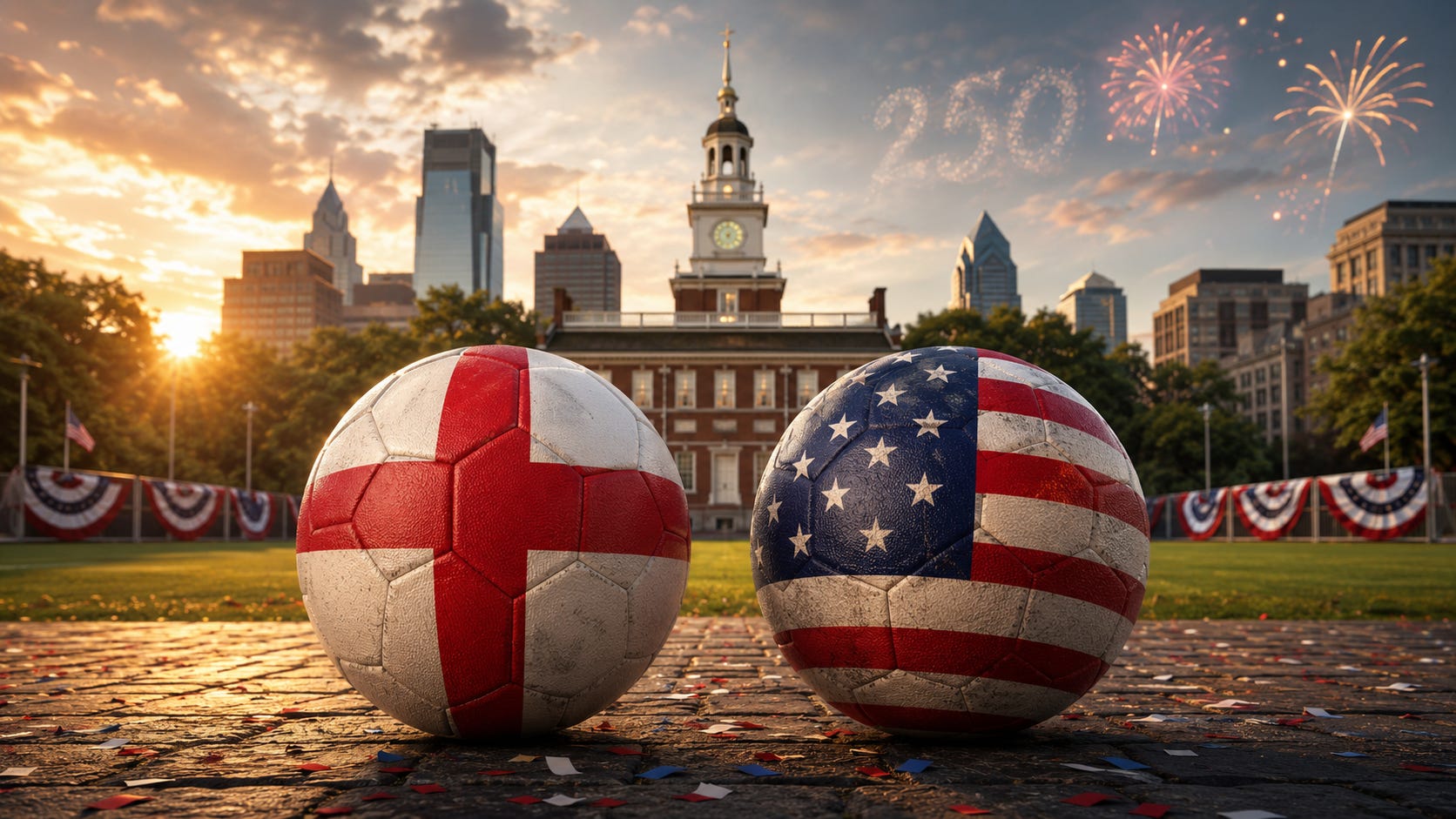
This is not a minor oversight. This is not a clerical error. This is the sort of thing that should have caused someone in Zurich to sit upright in the middle of the night, whisper “good heavens,” and immediately redraw the bracket with a quill pen.
Imagine the United States versus England. July 4, 2026. Philadelphia. The 250th anniversary of American independence.
It is difficult to imagine a more perfect sporting accident. It would have been less a soccer match than a constitutional amendment with corner kicks.
The pregame ceremony alone would have justified the ticket price. A bald eagle circling above the stadium. A Ben Franklin impersonator shaking his head at a Video Assistant Referee (VAR). A dramatic reading of the Declaration of Independence, followed by a polite request that England finally acknowledge the offside trap. Somewhere in the stands, a man in a powdered wig would be explaining expected goals to a child holding a Philly cheesesteak.
Instead, the match remains only a glorious hypothetical (see World Cup Brackets). The fixture the muses intended. The one the bracket denied.
And yet, even as a near miss, it gives us something worth considering.
The World Cup is often described as a global celebration, which is true, but too vague. It is also a rolling exhibition of national character. Every four years, countries send forth eleven men to demonstrate, in miniature, what centuries of geography, language, habit, diet, weather, and history have produced.
The Italians bring drama. The Germans bring structure. The Scotts bring kilts. The Brazilians bring beauty. The English bring the burden of having invented the game and then spending the next 150 years being emotionally punished by it.
The Americans bring optimism, athleticism, a suspiciously large number of people who call the sport “soccer,” and the cheerful belief that any international tradition can be improved with better parking and a halftime show.
This is why a World Cup in the United States (shared with Canada and Mexico) is such a fascinating spectacle. We are hosting the world and translating it into our own civic language. Stadiums become temporary embassies. Tailgates become foreign policy. National anthems become seminar texts. The beautiful game arrives on American shores and discovers that, in America, beauty must share space with merch tents, security lines, and a man from Ohio explaining why this is finally our year.
There is something deeply classical about all of this.
The ancient Greeks understood that athletic contests were never just athletic contests. The games were bound up with honor, national identity, excellence, and the public display of virtue. To compete was to reveal something about the soul. To watch was to participate, however imperfectly, in a shared civic drama.
The Romans, too, understood spectacle, though often with less moral restraint and substantially more lions.
Modern sports sit somewhere between the gymnasium and the circus. At their best, they call forth discipline, courage, loyalty, self-mastery, and love of place. At their worst, they become noise, commerce, and tribal shouting dressed in replica jerseys. The World Cup contains both. It is Homer with a beverage sponsor!
That is why the missed opportunity for a USA -England match-up in Philadelphia is so delicious. It would have been a revolutionary rematch, history compressed into ninety minutes.
After all, America’s political birth was an argument with England. The American Founders did not claim to be inventing liberty out of thin air. They appealed to inherited rights, the “rights of Englishmen,” English constitutional traditions, natural law, and the English Enlightenment idea that rulers are not gods. The Declaration of Independence was revolutionary, yes, but it was also deeply argumentative. It did not simply shout, “We’re leaving.” The Declaration made a case to the entire world for American Independence based upon the individual and collective rights of human beings.
In this sense, the American Revolution was the most consequential breakup letter in political history.
“We hold these truths to be self-evident” remains a far more elegant opening than “It’s not you, it’s Parliament.”
A soccer match between the United States and England on the Fourth of July in Philadelphia would not have settled anything, of course. Nations do not resolve centuries of constitutional development through penalty kicks, though admittedly this might improve several international disputes. But it would have staged, with comic perfection, one of the enduring realities of history: children grow up, inherit the family habits, change the locks, and eventually invite the parents over for a very expensive sporting event.
England gave America language, law, literature, parliamentary instincts, common law, Shakespeare, Milton, Locke, and a habit of arguing about taxes.
America responded by producing the Declaration of Independence, the Constitution, jazz, flight, cheeseburgers, Hollywood, blue jeans, the internet, and a national soccer team that periodically threatens to become interesting.
This is how civilizations work. They inherit. They rebel. They revise. They remember selectively. They build new worlds out of old materials and then pretend they started from scratch.
A classical education should train us to see this. History is not a warehouse of dead facts. It is a living conversation about human nature, political order, virtue, ambition, memory, and folly. The past is not behind us in the way a finished errand is behind us. It is beneath us, like a foundation. Ignore it long enough and the cracks begin to show.
That is why the setting matters.
Philadelphia is not just another host city. It is the city of the Declaration, the Constitutional Convention, Independence Hall, and the great American argument about ordered liberty. To play a World Cup knockout match there on July 4, 2026, is to place global sport inside a civic frame far larger than sport itself.
The world will come to Philadelphia to cheer, sing, groan, argue with referees, and overestimate its national team. But it will also come, whether it realizes it or not, to the place where a young nation announced that legitimate government depends upon something higher than power.
That is no small thing.
The irony is that soccer, for all its global grandeur, is still a game of limits. Lines matter. Rules matter. Time matters. The ball is either in or out. The player is either onside or offside. The referee may be wrong, catastrophically wrong, civilization shakingly wrong, but the existence of the rule is what makes the drama intelligible.
So too with liberty.
Freedom is not the absence of form. It is not every man sprinting wherever he pleases and calling it strategy. Real freedom depends upon order. It requires law, restraint, judgment, and shared meaning. A match without rules is not freer. It is just chaos with shin guards.
The American experiment has always depended on this tension. Liberty and order. Independence and inheritance. Rights and duties. The individual and the common good. The Founders knew that self-government would require self-governed people. A republic could not survive on slogans alone, no matter how handsomely they were printed on banners.
Which brings us back to soccer.
The great joke of the World Cup is that it briefly turns the world into a collection of intensely patriotic philosophers. Everyone suddenly has views on justice, fairness, courage, loyalty, time wasting, corruption, fate, and whether the referee should be investigated by an international tribunal. Every match becomes a seminar in human nature.
We learn who keeps composure under pressure. Who collapses when glory is close. Who mistakes flair for excellence. Who plays for himself. Who plays for something larger.
These are not small lessons. They are the old lessons, wearing cleats.
So yes, it is a shame that the United States will not be facing England in Philadelphia on July 4, 2026. The symbolism would have been almost too perfect, which is to say, perfect enough for satire and impossible enough for real life.
But perhaps the missed matchup is fitting.
America has always been shaped by what almost happened as much as by what did. The Revolution nearly failed. The Constitution required heroic rhetorical efforts by the Founders to secure passage to. The republic has endured crises that would have broken a less stubborn people. Our history is not a clean victory lap. It is a long, unruly, unfinished contest.
So, when the world gathers in Philadelphia on the Fourth of July, the point will not simply be who wins the match. The point will be that 250 years after a small collection of colonies declared independence from the most powerful empire on earth, the nations of the world will gather in that same city under rules, flags, songs, hopes, grievances, and loyalties of their own.
That is irony. That is history. That is comedy with a serious spine.
And somewhere, surely, King George III will be looking down on Lincoln Financial Field, watching thousands of Americans celebrate independence by obsessing over a British game, and wondering if perhaps the colonies were always going to be more trouble than they were worth.

Shannon Richards is a Senior Creative Director, digital strategist, and two-time Emmy Award-winning producer with more than 25 years of experience helping organizations tell clearer, stronger stories. Her work spans education, broadcast television, brand strategy, enrollment marketing, and digital media.