


On July 4, 1776, just moments after it had approved the Declaration of Independence, the Continental Congress appointed a committee to design a “great seal” for the newly asserted republic. The three members of this committee were some of the biggest names in the American Revolution: John Adams, Benjamin Franklin, and Thomas Jefferson. All three men had been on the “Committee of Five” that drafted the Declaration.
As committee assignments go, this probably seemed like a fun one. The committee’s job was to represent visually what the Declaration of Independence was all about. They had done the hard work of writing the Declaration; now they just had to turn it into a picture.
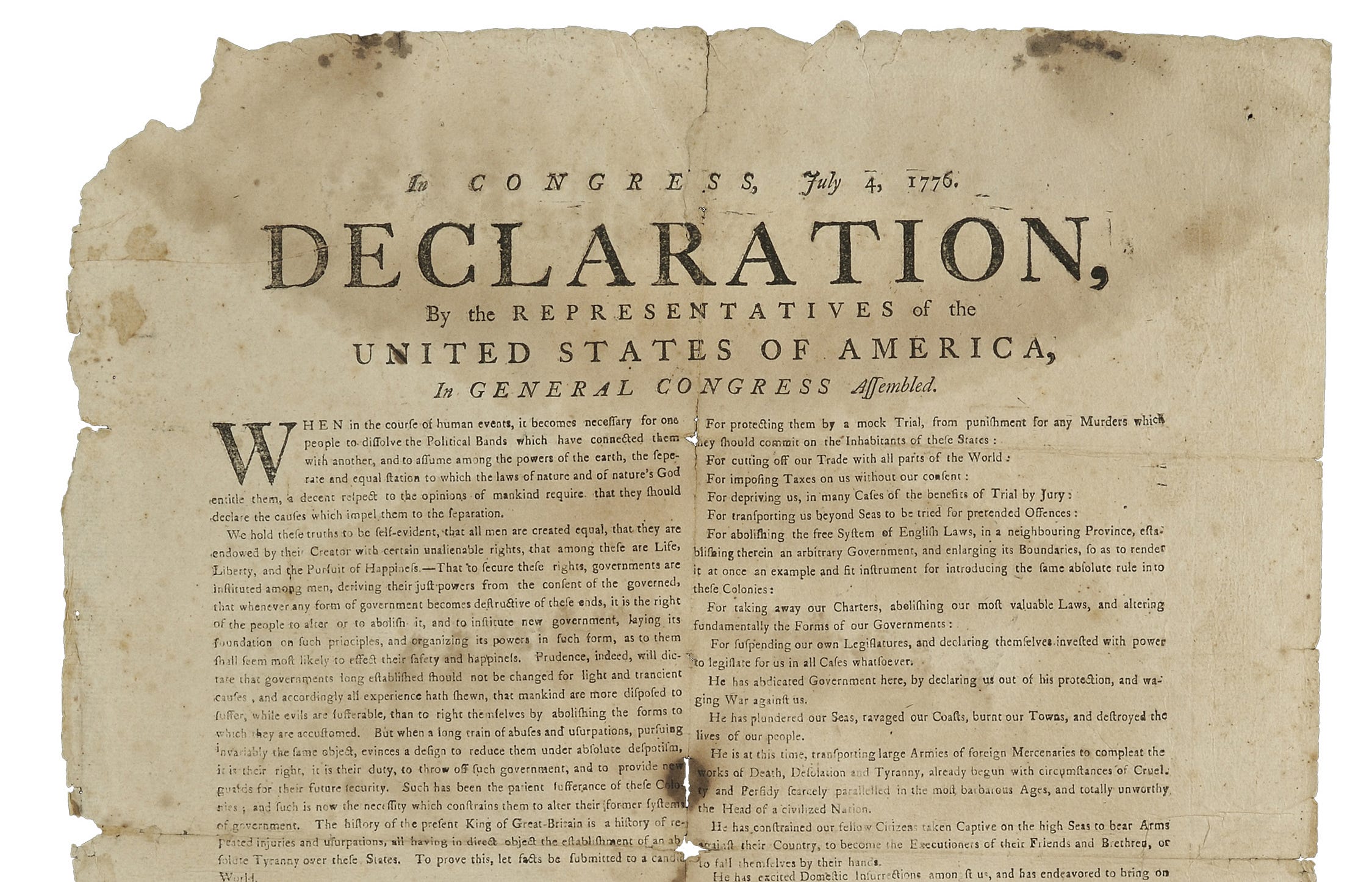
But within weeks, the committee members were locked in battle. Franklin insisted that the Great Seal show a picture of “Moses standing on the Shore, and extending his Hand over the Sea.” In other words, Franklin insisted that the Great Seal of the United States show a picture from the Story of Exodus in the Hebrew Bible.
Jefferson disagreed. He thought it was clear that the Great Seal should show a picture of “The Children of Israel in the Wilderness” being “led by a pillar of fire.” In other words, Jefferson insisted that the Great Seal show a different picture from the Exodus story.
The fight between Franklin and Jefferson never got resolved. They couldn’t resolve their disagreement, and the Continental Congress would table their committee’s report.
But even though their committee failed, its failure helps reveal something important about the Declaration of Independence and the American founding. For it’s not hard to see what is interesting about the Franklin and Jefferson proposals: These two sons of the modern Enlightenment, offered their first chance to depict the liberty they had just declared in writing, looked to the ancient Exodus story.
Most educated Americans know that European social-contract philosophers, like John Locke, influenced the Declaration of Independence. But few Americans appreciate the influence of the Exodus story, not just on the Declaration of Independence but on the entire American founding. Though it might surprise many to hear it, there is no arguing how important the Exodus story was to the founders: the most-cited source in the political writings of the early republic is the Book of Deuteronomy.1
The authors and signers of the Declaration had grown up in a culture where the Exodus story had long shaped political ideas. Though the Puritans inhabited a place they called “New England,” they understood themselves to be building a New Israel. They called theirs an “errand into the wilderness” and understood their pursuit of liberty in terms set out by the Exodus story.2 Today, if you go to Plymouth, Massachusetts, to visit the National Monument to the Forefathers—formerly known as the Pilgrim Monument—you will see a female figure wearing an ephod, the priestly garment described in the Exodus. That garment is a quiet hat-tip to Puritan self-understanding, which was rooted in the Exodus story.
By the late 1700s, the Exodus story gave much of the form and language to the project of American independence. Consider that the Liberty Bell, forged in the early 1750s for the Pennsylvania State House, tells us to “proclaim liberty throughout the land unto all the inhabitants thereof”—the words that God spoke to Moses on Mount Sinai. Or consider that in 1777, John Adams worried to Benjamin Rush that the Continental Congress was making George Washington into a “golden calf.”3 Throughout the founding period, the language of the Exodus story dominated American politics.
This does not mean that the American founders, or the authors of the Declaration of Independence, understood their political project in religious terms. It is well-known, for instance, that neither Franklin nor Jefferson were religious in any traditional sense. Both advocated fiercely for the separation of church and state. But both thought that the Exodus story had important lessons to teach all of us—Jewish, Christian, or neither—about the perils and possibilities of pursuing collective freedom.
This year, as the nation marks the 250th anniversary of the signing of the Declaration of Independence, we also mark the 250th anniversary of the failed Great Seal committee. In honor of the story of both, it behooves all Americans to revisit the ancient story that gave the Declaration’s authors many pictures of political freedom: the Exodus.

Susan McWilliams Barndt is Professor of Politics at Pomona College and the William F. Podlich Distnguished Fellow in Government at Claremont McKenna College. She serves as the elected president of the American Political Thought section of the American Political Science Association.
McWilliams is the author of The American Road Trip and American Political Thought (2018) and Traveling Back: Toward a Global Political Theory (2014). She is also the editor of A Political Companion to James Baldwin (2017) and a co-editor of several books, including The Best Kind of College: An Insiders’ Guide to America's Small Liberal Arts Colleges (2015) and The Princeton History of American Political Thought (forthcoming).
McWilliams is the co-editor of the American Political Thought book series at the University Press of Kansas and a past editor of the peer-reviewed journal American Political Thought. Her writing has appeared in both scholarly and popular journals, and she is a regular media commentator on American politics for outlets such as The Atlantic, Business Insider, KPCC's AirTalk, LiveNOW From FOX, The Los Angeles Times, Ms. Magazine, The Nation, The New York Times, Newsweek, Pacifica Radio, Politico, the Tavis Smiley Show, and “Today in LA” on KNBC.
For her work, McWilliams has received accolades including the Graves Award in the Humanities, a National Endowment for the Humanities Fellowship and the Jack Miller Center's Teaching Excellence Award in Higher Education.
McWilliams holds a B.A. in political science and Russian from Amherst College, an M.A. and Ph.D. in politics from Princeton University, and a Certificate in Advanced Education from Havard University’s Graduate School of Education