


Imagine for a moment a school where no adults showed up for an entire month, but students still did. What would happen?
Some students would attempt their studies but struggle and peter out as they encounter novel and increasingly difficult concepts. Another contingent would follow their own childish inclinations: eternal recess, free reign in the gym, phone time. And a final group would exert their power—the bullies, troublemakers, and ne’er-do-wells.
With time, even the well-meaning kids would find themselves embroiled in conflict. Any recess attendant has seen it: two well-meaning students who find themselves in a verbal altercation over something simple. One student kicks a ball into the field; another student sees this ball sitting alone and begins to play with it. Both believe they have a claim to it. Without an adult there to adjudicate right from wrong, the stronger or more popular kid would come out on top, regardless of the merits of his case.
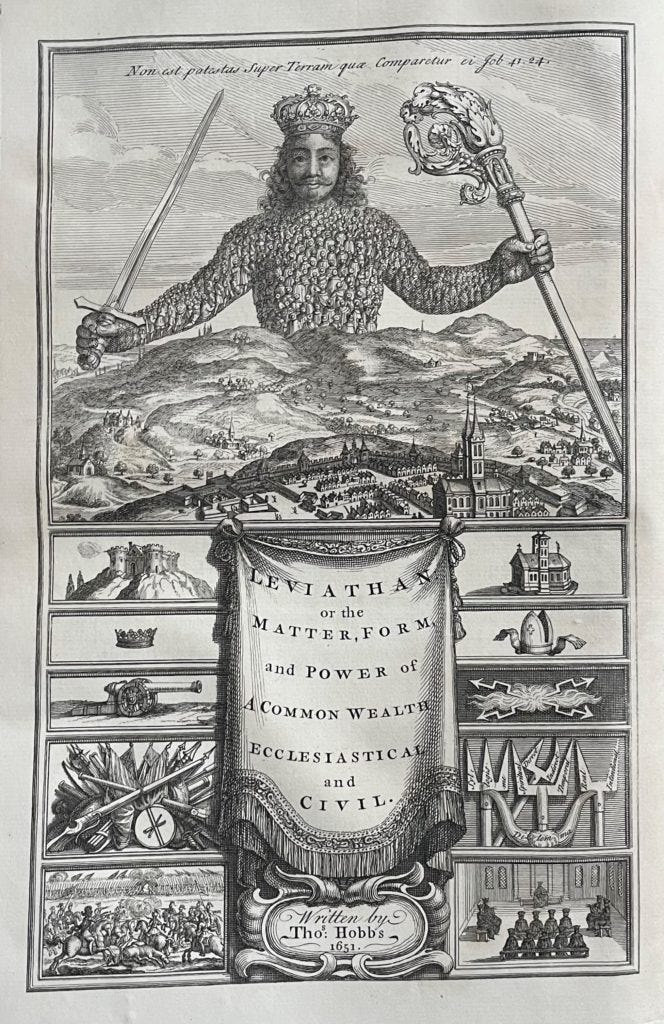
A school without adults would not necessarily descend into some tribal, murderous dystopia (although some schools might), but it would not be a thriving or even safe place either.
Astute readers will have noticed the not-so-subtle allusions to Thomas Hobbes, the seventeenth-century political philosopher whose magnum opus Leviathan wrestled with the state of nature, the justification and use of political power, and the ideal structures of government. He was truly groundbreaking in that he pioneered justifications for political authority, not through appeals to divine right, but rather a rationalist, secular perspective.
To be clear, neither route to justify authority—through divinely ordained relations or materialistic rationalizations—shouldbe in inherent conflict with the other. As mathematician and lay theologian John Lennox has joked, if you asked why a pot of water is boiling, a physicist might answer “Because of heat transfer from the flame and water molecules changing state,” while Lennox himself might answer “Because I would very much like a cup of tea.” These explanations can be complementary, not necessarily contradictory.
Engagement with any great mind—both the complements and contradictions—can prove fruitful. Hobbes’ core insights about human nature and the role of authority provide profound guidance regarding how to most judiciously order both a school and the classroom, even if we shy away from his preferences for absolute monarchy and an education order thereto. The Hobbesian worldview suggests that teachers and administrators have not only the right, but the obligation to assert their authority towards both rightly ordering the classroom and directing students to higher ends.
The Hobbesian Classroom
Why should students listen to and obey their teachers?
When I first started teaching, fresh out of college, never having held a position of authority in my life, I struggled with this question. Before I worried if students even would obey my commands in the classroom, I wondered why they should. Who was I to demand that others obey me?
In my role as an instructional coach and school leader, I’ve seen other teachers struggle likewise. This irresolution manifests in small, subtle behaviors. Their voice lacks command. Students tip-toe across behavioral lines. Teachers allow a preponderance of little transgressions—whispers during instruction or words spoken out of turn. Administrators implore students to behave, cajoling them in the office, but are reticent to give a forceful punishment.
And while I cannot prove it, I suspects many teachers doubt that they themselves are worth obeying. Everyone can nod along to discussions of consequences or basic order, but speak of compliance, authority, punishment, deference, or decorum, and educators grow uneasy. Nevertheless teachers and school leaders can and should wield authority. It is an essential, arguably the essential element, to any well-ordered society in general and school in particular.
To begin building towards a philosophy of justified authority, Thomas Hobbes proposes a state of nature where there is no government, no police, no rulers, and no laws. Such a society-less world would be a chaotic, violent place, Hobbes argues—a war of “every man against every man,” where life would be “solitary, nasty, poor, brutish, and short.”
Perhaps we members of modern, democratic republics might like to flatter ourselves into thinking that we would continue to live virtuously in such a world. But suppose a few roving bands of criminals began breaking into homes, stealing food or harming loved ones, and setting buildings ablaze for fame and fun. It would only take a handful of individuals unconstrained by laws to induce fear across a city or town. Many formerly selfless and virtuous people would turn to self-preservation as the foundation for every decision. There would be no way to enforce claims of private property except through brute force in the name of self-defense. Why, after all, do we all still lock your homes at night, Hobbes asked?
And such a society would also be entirely unproductive. “There is no place for Industry,” he writes, “because the fruit thereof is uncertain.” Why store up wealth or create anything if there’s no security? Consequently, he argues, there would be no culture, no commerce, no commodities, no beautiful buildings or structure, no scientific advancement, no arts, no history, and no letters. In short, no society.
In the Hobbesian state of nature, everyone would have a claim to everything, and thus nothing outside of force could maintain that claim. A man stumbles upon a tree in a forest with just enough apples left to feed his family. Moments later, another man stumbles upon the same tree. Does “finders’ keepers” necessarily rule the day? That’s hardly a more virtuous or high-minded claim than simple “might makes right.”
These two men could make an agreement, shake hands, and work together, but why should one necessarily trust the other? Someone must enforce the contract. Over and above them both must be an authority that ensures both sides uphold their side of the bargain.
From this state of nature, Hobbes derives a justification for political authority. We implicitly consent to a governmental Leviathan that curtails our own individual liberty in return for peace and order.
Translating that justification to the classroom, teachers must wield authority to maintain basic order and safety, to stave off a state of nature in school. Parents, in turn, consent to restrictions on their child’s liberty in order that their child may learn and grow in a safe environment.
Anyone who has worked in schools before knows that the state of nature analogy is not too abstract. I have worked in real schools where the administration stripped teachers of authority, and it was chaos. A few students still sought to attend to their studies, but only with difficulty. Others caused no real problems but did what they pleased. And a final contingent forced their own order onto the system, and it was not a benevolent regime. In many ways, Hobbes’ predictions about society were born out in the school building: there was no productivity, no safety, no learning, no discussions, no reading, no practice, nothing that could justifiably be called “education.”
As a society, we have decided collectively to fund a public education system, elect the school board to govern it, and delegate the day-to-day operations of that building to the building personnel. Teacher authority keeps children safe until schools return responsibility to parents. Certain basic rules must be enforced: Don’t run with scissors. Don’t stick your finger in the socket. Don’t throw rocks at recess. Teachers represent the sovereign in the school; they enforce order. Insofar as the alternative is chaos, teachers have the right and obligation to enforce rules. Failure to do so is a violation of the implicit contract between parents and teachers, society and schools. The classroom is not a democracy. The teacher is the Leviathan. But what kind of Leviathan?
Is there a higher foundation for a teacher and administrator’s authority than this negative case—that their power is preferable to chaos? Why did we institute schools in the first place?
In his De Cive, Hobbes observed that all men are born unfit for society “as all men are born infants.” In Shakespeare’s words, we come “mewling and puking in the nurse’s arms,” unable to feed ourselves, cloth ourselves, speak, move, or do much of anything. Hobbes argued that “Man is made fit for society not by nature, but by discipline.”
Romantics such as Jean-Jacques Rousseau took a different view, arguing that “the education of the earliest years should be merely negative.” Rousseau proposed an alternative state of nature: All was roses and sunshine until society came with its rules and regulations and corrupted the noble savage’s Eden-like utopia. He argued that teachers and parents ought to simply leave children to be and they will develop as needed.
Experience and time have proven that there’s much wisdom in Hobbes and outright falsehood in Rousseau. A child left to their own devices will not learn to read, do math, or control their behavior. Adults and children alike can be wise, courageous, gentle, kind, and loving, but so too can they be cruel, petty, factious, and downright wicked. Call it sin or imperfections left from mindless evolution, there’s something rotten in the heart of man.
A city composed exclusively of illiterate, uncivilized neanderthals would greatly differ from modern New York or any small town pinned on a map. It would not be a pleasant place to live. Hobbes wrote that “where the people are not well instructed in their Duty,” there will be civil disorder. Certain habits, certain pieces of knowledge, even certain opinions and rules are essential to a peaceable society.
Schools are one of the institutions that we employ—along with family and the church—to carry out this civilizing task. Teachers are the first stewards of our cultural inheritance and societal maintenance.
They have received a commission—that is, an official command from a place of authority—to hand along the knowledge and norms on and through which our civilization stands and is perpetuated to the next generation. And it’s this sense of responsibility and authority that I observed many teachers lack. In the American Mind, John Peterson of Hillsdale College captured it well:
You can see it on the faces of the teachers, in the cowed words of the administrators. They’re scared of their students. I don’t mean that they think their students will hurt them physically. Rather, they are afraid to assert any real authority, to stand in the places of adults and representatives of a good and lasting order and pass any serious judgment on the habits and choices of their students.
Just as I keep my children from playing in the street for their own safety—I can say so with authority because I do, in fact, know better—we can demand that our students study, listen, learn, write, and read. It’s a fact of life that adults usually do know better. To emphasize Peterson’s words, parents and teachers alike are “representatives of a good and lasting order.” We stand with the authority of the Western tradition, empowering us to bring the next generation into it.
And here we start to break from Hobbes. His first principles led him to argue for an absolute authoritarian. The cover Leviathan depicts a giant king himself made up of hundreds of individuals, representing submission to total power. As such, he saw the role of schools and universities as forming children towards this state, the beliefs as prescribed by the sovereign and a natural stance of submission.
We’re instead commissioned to create students fit for a modern, liberal, pluralistic society—that is students who are free-thinking yet virtuous.It is liberal arts education that achieves these ends. Through an education in their Western inheritance, the students learn much factual knowledge, but they gain something more than a mere keen intellect. In the structure of well-ordered schools, they develop virtuous habits. They learn prudence through failure, wisdom through the counsel of great authors, patience through engaging with long works, and justice and self-control through discipline.
Teachers derive their authority from the knowledge that bringing children into this tradition is a good, worthwhile project. The foundation of teacher authority begins with mere safety and ends with virtuous citizens.
Teachers as Leviathans
Many schools spurn the inherent good of authority. Insofar as rules are enforced, policy targets discreet behaviors. For example, some states - such as California – and many schools prohibit the use of suspensions for “willful defiance.” Mainstream education publications bemoan school rules that target vague concepts such as “insubordination” instead of clear transgressions such as fighting or drugs. Submission to authority is not the expectation.
But these policies and opinions misunderstand the role of authority. In reality, the infractions that they argue deserve no punishment—defiance, insubordination, direct refusal to comply with the orders of an adult—are really the root of the issue. If students are not expected to comply with a teacher’s request, however small, then the entire edifice crumbles.
Hobbes writes that “The skill of making and maintaining common-wealths consisteth in certain rules as doth arithmetic and geometry.” Schools, too, require carefully crafted expectations, rules, goals, guidance, routines, schedules, space, and activities. Each should be carefully thought through with the purpose of directing students towards the higher things of an education, not just rules for submission but for training in liberality, as a musician may trudge through their scales today that they might play Beethoven tomorrow.
Quiet hallways allow students to focus. That students wait to speak allows others to formulate their own thoughts and facilitates the procedures of academic discussions. Even how students exit and enter the room can either promote efficiency and decorum or disorder and chaos.
When it comes to upholding these rules and routines, there’s either the expectation that students follow these rules or there isn’t. To pick and choose rules with which students must comply undercuts the very authority on which a system functions. Perhaps we can let it slide when one student whispers out of turn or refuses to sit somewhere other than their assigned seat. But what if they all did?
To maintain order, schools must fuss over even the smallest infractions. Establish a teacher’s authority over the small things—a request to pick up a piece of trash or slight uniform infractions—and there is less of a need to enforce the big rules. To quote another political philosopher, Alexis de Tocqueville, “when justice is more certain and more mild, it is more efficacious.”
For example, I have observed many teachers who provide one, two, or three warnings—or they ignore misbehavior so long as it is small and unobtrusive—before they finally lashing out in anger and taking away a day’s worth of recess. What does this communicate to students? Not that they must listen or follow the rules, but they must only do so when their teacher is angry. The incentives encourage students to misbehave.
Conversely, if that same teacher were instead to correct behavior immediately, with a small, unobtrusive consequence—one minute from recess perhaps every time a student speaks out of turn—what does that communicate? A teacher’s authority must be respected as such. Meanwhile, the incentives discourage even the smallest transgressions; there’s a disincentive attached to every single one.
It’s essential to note that the above discussion in no way justifies a dictatorial, imperious teacher. Suggesting that teachers be authorities does not justify a Miss Trunchbull-like tyrant grabbing boys by the ears and tossing them across the room because they forget to mind their manners.
I’ve watched plenty of teachers abuse their authority: a teacher who leveraged his students’ insecurities to instill fear, a principal who ran a school based on her own cliques and preferences for the day instead of well-established policies, and teachers who punished entire classes in ineffective attempts to force one child to behave.
Quite the contrary, recognizing the authority entrusted in teachers necessitates an even higher calling towards virtue. Teachers are more than babysitters. They’re not automatons who run through a curriculum. They are leaders in their own classrooms. They must ever have in mind the good of their own students. They must consider deeply their instructional and curricular choices. They should strive to direct their students beyond mere safety and basic engagement and towards higher things—goodness, truth, and beauty.
Often times, from the best teachers, authority goes unnoticed. When a community of students respects their teacher for his or her mastery of content, instructional excellence, personal virtue, and educational passion, they comply from a natural place of respect.
The question I asked myself as a first-year teacher—why should students listen to me?—was never really about me. It was about what I represented: an adult entrusted with passing something valuable on to the next generation. Teachers are not in classrooms to be liked, or feared. They are there because children do not raise themselves, learning does not happen on its own, and because the alternative is chaos.
Authority isn’t a dirty word. It’s the precondition that makes everything else possible.

Daniel Buck is a research fellow at the American Enterprise Institute (AEI), director of the Conservative Education Reform Network (CERN), and an affiliate of AEI’s James Q. Wilson Program in K–12 Education Studies, where his work focuses on K–12 education, charter schooling, curriculum reform, and school safety and discipline.
Before joining AEI, Mr. Buck was a senior fellow at the Thomas B. Fordham Institute, an assistant principal at Lake County Classical Academy, and a classroom teacher at Hope Christian Schools, Holy Spirit Middle School, and Green Bay Area Public Schools.
His work has appeared in the popular press, including The Wall Street Journal, National Affairs, and National Review. Mr. Buck is the author of What Is Wrong with Our Schools? (2022).
Mr. Buck has a master’s degree and a bachelor’s degree from the University of Wisconsin–Madison.