


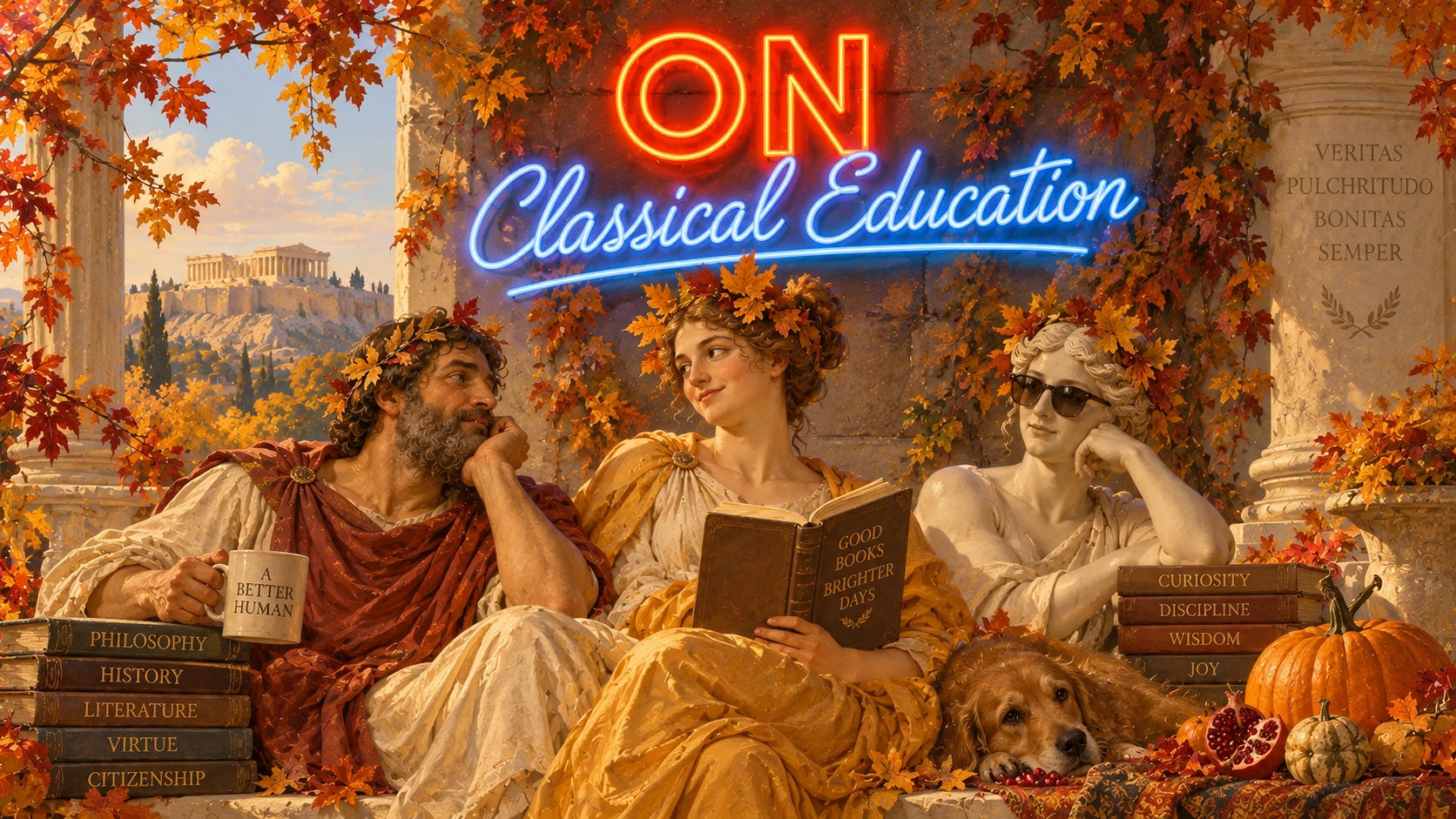
One year ago, ON Classical Education launched with a simple ambition: to create a place for serious conversation about classical education, its purposes, its practices, its inheritance, and its future.
Twelve months later, that conversation has grown.
Across its first year, ON Classical Education has brought together teachers, school leaders, scholars, writers, scholars, and practitioners to examine the questions and ideas that animate classical education from the deeply practical to the philosophical. How should we teach? What should we teach? What is a school for? What does it mean to form a free person? What do the great books still have to say to us? And how do we know whether the practices we have inherited are actually accomplishing what we believe they do?
That last question is at the heart of something new in this anniversary issue.
Introducing the Empeiria File
In “Looking at” Classical Education: Introducing ON Classical Education’s Empeiria File, Albert Cheng and Helen Baxendale introduce a new section devoted to empirical research relevant to classical education.
Classical educators have long made substantial claims about what education can accomplish: forming the whole person, cultivating wisdom and virtue, shaping affections, strengthening communities, and helping human beings flourish. The Empeiria File asks whether empirical research can help us examine some of those claims more carefully.
Cheng and Baxendale draw on C.S. Lewis’s distinction between “looking at” and “looking along” something to argue that empirical inquiry need not replace the philosophical commitments or practical wisdom of classical educators. It can offer another vantage point. Research may validate long-standing practices, challenge assumptions, illuminate difficult tradeoffs, or help teachers and leaders refine their craft.
The Empeiria File will feature accessible versions of original research, along with summaries and commentary on studies examining the classical education sector, its outcomes, and specific practices such as the impact of handwriting, Socratic dialogue, reading whole books, and knowledge-rich curriculum.
The Empeiria File is a fitting addition to ON Classical Education as it enters its second year, to provide another way for us to ask whether we are seeing and implementing the principles and content of classical education clearly and effectively.
Pedagogy and Curriculum
This issue’s Pedagogy and Curriculum section begins where many classical teachers spend much of their day: in the classroom.
In “For All Teachers of Socratic Seminars: Seven (Physical) Things that Are Stunting Your Discussions,” Andrew Ellison challenges teachers to look beyond the quality of their questions when a seminar falls flat. The culprit may be far more ordinary: the shape of the tables, clutter, posture, closed books, poorly timed breaks, repetitive routines, or students who simply cannot hear one another. Ellison’s larger argument is deceptively simple. The intellectual life of a seminar depends significantly on its physical conditions.
Luke Patient offers a different provocation in “Latin in the Valley of Dry Bones.” His argument begins with a statement many Latin teachers spend their careers resisting: Latin is a dead language. Patient contends that this is not something classical educators should be afraid to admit. Newer methods such as spoken Latin, comprehensible input, and active language exercises may be powerful tools, but he argues they should remain ordered toward an older goal: helping students encounter the authentic texts, ideas, and world preserved in the study of “dead” Latin.
In “The Siren Song of Marxism,” Jeannette DeCelles-Zwerneman discusses the curriculum’s civic responsibilities. She argues for a more sustained treatment of American history, the history of communist regimes, dissident literature, and economics in order to prepare students to evaluate political and economic ideas seriously rather than merely absorb them.
Daniel Murphy asks classical educators to examine upper school classical mathematics curriculum in “Recovering the Quadrivium.” Classical schools may teach literature, history, and language very differently from conventional schools, he observes, but they often retain nearly the same mathematics sequence and assumptions about what mathematics is for as regular public schools. Murphy asks, just as classical education returns to Plato, Boethius, and the great books in the older liberal arts tradition, whether the quadrivium might recover mathematics as more than utility or mental training, and instead as a path toward wonder, truth, and philosophy.
And in “Two Concepts of Educational Liberty,” Daniel Buck begins with a classroom paradox: how can schools claim to form free human beings while constantly telling children where to sit, when to speak, and what to do? Buck draws on Isaiah Berlin’s distinction between negative and positive liberty to argue that temporary constraints in the classroom and curriculum can enlarge a student’s future freedom of thought beyond “their own insular interests to instead direct them towards virtue and truth.” Genuine virtue, Buck reminds us, requires the freedom to choose. As a result, he also cautions educators to recognize the line between formation and authoritarianism in the classroom, so that students become “self-governing individuals” through a truly liberal education.
Leadership and Operations
The two pieces in Leadership and Operations turn their attention toward the adults responsible for shaping schools.
In “An Invitation,” Cammie Passey recounts a moment from her first year in a classical school, when a classroom motto she had proudly created prompted a gentle challenge from her headmaster. What followed was not a directive, but a conversation, and ultimately a transformation in how she understood education itself. In her essay, Passey offers a reflection on the role of the teacher, school leadership, humility, belonging, and the realization that curriculum, rigor, and classroom culture are ultimately in service to the deeper, more important goal of forming the human person. Passey’s intention is to speak to and welcome every teacher making the transition to teach in a classical school.
Jerilyn Olson tackles one of the apparently more mundane artifacts of school life in “Subject: Object(ive) (Classical Pedagogy and Lesson Planning).” Are lesson objectives useful tools, or remnants of a technocratic model of schooling? Olson argues that classical educators need not reject objectives, but should order them properly. A good objective serves the larger purposes of the discipline and the formation of the student. Objectives and goal setting in class planning should help teachers prepare with intention but without flattening wonder, discovery, or the encounter between a student and the thing being studied.
The Great Books and Ideas
The Great Books and Ideas section ranges from Homer to Lincoln, from the Constitution to the structure of a high school syllabus.
Robert Thornett’s “Across the Trojan Plain: How Geography Shapes Possibilities in The Iliad” asks readers to notice what is literally beneath the feet of Homer’s heroes. The Trojan Plain is not merely a setting. Its openness shapes visibility, mobility, vulnerability, military strategy, and the pursuit of glory itself. Thornett shows how landscape can become one of the epic’s most powerful forces. His bigger goal is to encourage classical educators not to neglect what the geography of any text adds to the story.
In “Your Course Is Their Cosmos,” Mark Bauerlein reflects on the power of a thoughtfully constructed syllabus. He argues that course does more than assemble readings. It quietly presents students with a picture of reality: what matters, what belongs to the past, what deserves admiration, and whether human achievement forms part of a meaningful inheritance. Against the fragmentation of contemporary media culture, a coherent humanities course can offer students order, continuity, and a world worth entering.
Joseph Knippenberg’s “The Constitution and the Consent of the Governed” asks citizens to move beyond knowing what the Constitution says toward understanding why it says it. Using a recent Supreme Court decision as a case study, Knippenberg argues that constitutional self-government depends on citizens who understand the reasoning and principles beneath the legal text rather than simply outsourcing judgment to courts or experts.
And in “Can a Republic Long Endure? Abraham Lincoln’s Reflections on the Perpetuation of Our Institutions,” Carol McNamara returns to Lincoln’s 1838 Lyceum Address to consider what it takes not merely to found a republic, but to preserve one. As a 28 year old Illionois state legislator, Lincoln warned us about the dangers of lawlessness, complacency, fading civic memory, and unchecked ambition. McNamara reminds us of his answer that civic education, reverence for the rule of law, disciplined reason, and the deliberate transmission of constitutional principles from one generation to the next.
Book Reviews
Finally, this issue includes two reviews that are really arguments about reading itself.
In “Chapter House Books: A Treasury of Children’s Literature,” Christen Arbogast considers the formative power of the stories families place in children’s hands. In her review the Chapter House collections, she makes the case for beautiful books, traditional stories, moral imagination, cultural inheritance, and the irreplaceable experience of reading aloud together.
Annika Hernandez explores another inheritance in “Before Classical Education, There Was New Criticism.” Reviewing John Guillory’s On Close Reading, Hernandez traces the intellectual roots of practices now familiar in classical literature classrooms: sustained attention to the text, formal analysis, textual evidence, and the conviction that great works reward repeated interpretation. Her review raises a provocative question for classical educators: how much of what we think of as classical literary pedagogy was shaped by the twentieth-century movement known as New Criticism?
Into Year Two
Taken together, these 14 pieces reflect the breadth of the conversation ON Classical Education set out to foster one year ago.
The articles in this first anniversary edition of ON Classical Education address the great books and authors, pedagogy and curriculum debates that occupy classical educators every day, when we converse among ourselves and when we engage with our students in the classroom.
Our goal at ON Classical Education is to publish essays that draw the classical community into the important conversation about how to reorient K-12 education towards the serious exchange of ideas across a curriculum of literature, math, history, philosophy, the arts and sciences that always aims to form thoughtful students who contribute to the best future for human beings.
We invite classical educators from every corner of the community to join us for year two at ON Classical Education, to subscribe, submit articles for our consideration, and join the conversation.
What are good venues to publish essays related to classical education?