


As the 250th anniversary of the creation of the United States is approaching, it’s been an enlightening experience to look back at how math education was developed at the birth of our country. Upon researching for my presentation at the 2026 Great Hearts National Symposium for Classical Education, it became apparent that the same challenges our young country faced remain huge roadblocks for educators today. How is that possible? One would assume math education had advanced exponentially since those early days, as we have learned more about the way students learn through science and technology. However, the same argument over whether more “traditional” learning or robust conceptual learning is best has continued for the last 250 years and is still a debate today.
The Two Camps for Mathematical Teaching
As mentioned above, there tends to be two camps of educators debating the way students should learn mathematics. One camp could be called the “Traditionalists.” These educators believe that students should learn the “rules” of mathematics and repeat. A seasoned instructor usually models a problem and invites students to follow along and do 10 more similar problems. This “Traditionalist” camp emphasizes repetition and memorization.
This type of teaching began with one of the first textbooks published in the United States, Nicolas Pike’s Arithmetic, published in 1788, and continued with other series, including P.E. Bates Botham’s The Common School Arithmetic in 1832, and traditional back-to-basics curricula. These early math textbooks were designed to meet the needs of standardized testing, beginning in the 1980s (Larson, 2016). This methodology is especially evident when students need to learn traditional arithmetic, and when moving into algebra and calculus.
The other camp of math educators could be referred to as “New Math” followers. These “New Math” educators tend to focus more on conceptual learning, based on the ideas of the work of researchers such as Richard Skemp and Jerome Bruner. These educators tend to present problems to students with hands-on materials. They ask students to decide how the problem should be solved and to consider why it should be solved that way. The “New Math” educators emphasize connecting mathematical ideas and utilizing the hierarchy of mathematics.
The idea of conceptual learning began as a response to the first “traditional” textbook, with Warren Colburn’s An Arithmetic on the Plan of Pestalozzi in 1821 and the large math boom with space exploration that began in the 1950’s (Larson, 2016). As states have moved to more standards-based education beginning in the early 2000s, the emphasis on understanding the why and how of the way mathematics works was widely adopted.
Listen to any type of social media or news outlet that discusses math education, and you will hear the ongoing debate today between these two camps. Outraged parents who are unable to help their students with their homework post rants about how the “new math” makes no sense: they just want their students to be able to say their math facts quickly. States and educators fret over test scores that show only 39% of students are able to apply mathematics in a way that will be needed for their future professions (NAEP Math 2024). However, these very same arguments have existed since the start of our country as the pendulum of education has swung back and forth between the two arguing camps.
The True Beauty of Mathematics
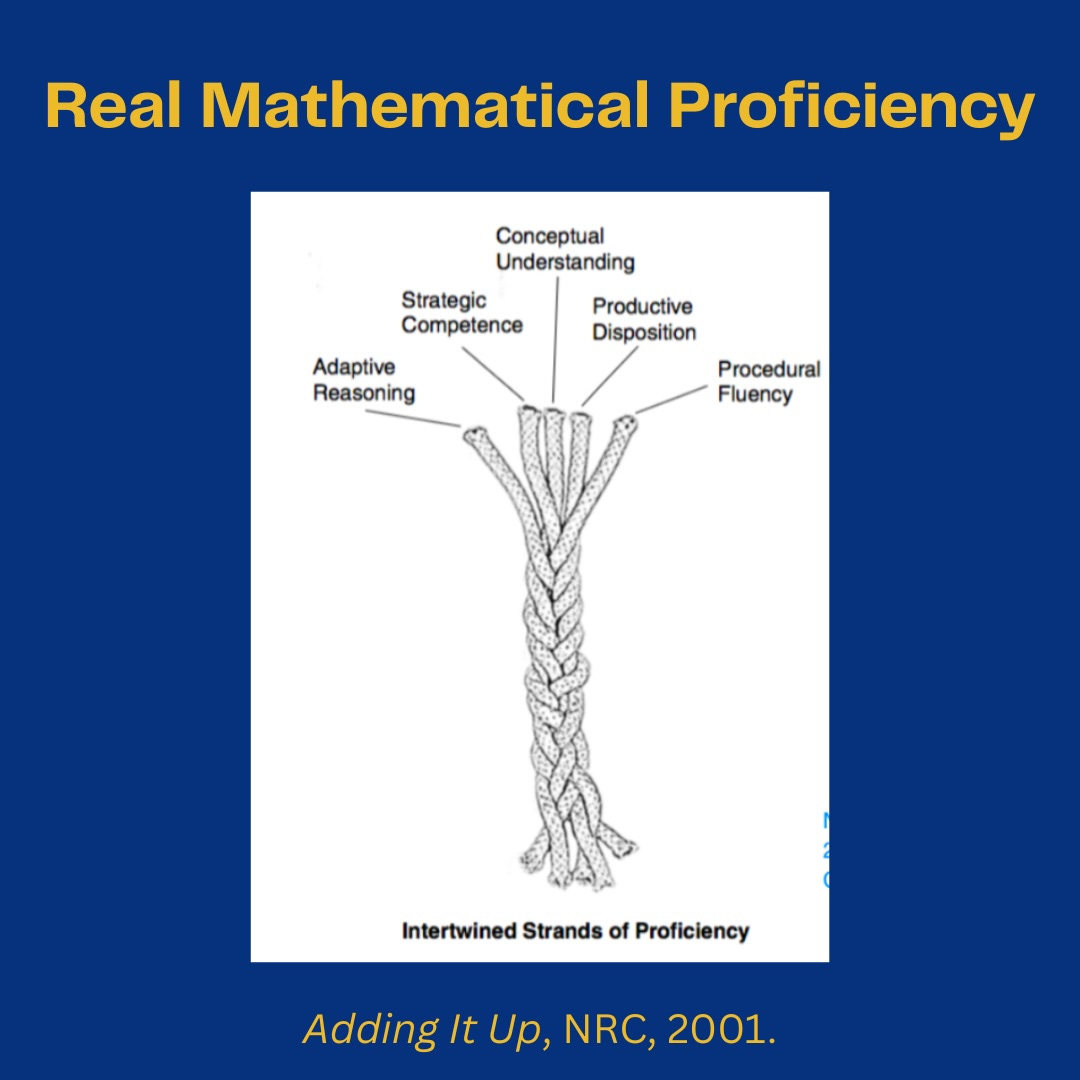
Instead of swinging back and forth on the pendulum between one approach and then the other, we should concentrate on true mathematics, which focuses on five elements of math education that include both viewpoints. The National Council of Teachers of Mathematics defines mathematical proficiency as: adaptive reasoning, strategic competence, conceptual understanding, productive disposition, and procedural fluency. Mathematical proficiency is presented as strands that are woven together to create one solid approach to teaching mathematics (NCTM, 2001). The arguments from both camps are valid but need to be combined to create a well-rounded learner who knows and can apply mathematics.
The “Traditional” camp is correct that students need speed and repetition to access multi-step problems efficiently. The memorization of math facts and formulas help students to do that well. However, the “Conceptual Learning” camp accurately recognizes that students also need to know why they chose a specific formula or algorithm, and whether their answer makes sense. The two components need to be intertwined effectively so that students understand mathematics as a process and learn how to utilize its components.
The two camps have been in opposition from the start of our country, and they both have accurate arguments. Each is a singular piece that needs to be combined to make a true robust curriculum that produces well-rounded mathematical problem-solvers. The mathematics itself is unchanging. Algebra will always be algebra. There’s nothing “new” in mathematics except for an approach that some may have not learned in their own mathematical experience.
When combining these two approaches to create one complete definition of proficiency, we are providing our students the skill set they will need to be successful in today’s workforce that requires critical and analytical thinking. We are also providing a love for truth and beauty, which classical education emphasizes in other subject areas, and should be considered as a major component for mathematics, as well.
Teaching True Mathematics Challenges
The challenge with teaching mathematics using the reasoning from both camps and the definition from NCTM to create a truly proficient learner is that many current adults were never taught mathematics using both approaches. Depending on where the pendulum was located during an educator’s or parent’s learning experience, they may have not learned the why and how components of mathematics. This omission can create a huge disconnect as educators try to explain mathematics in a way they didn’t learn and parents try to understand what their student is doing at home. The teacher or parent can feel inadequate and immediately blame the curriculum, teacher, or school. Many believe that if they are unable to do the math, it must be some form of “new math” that was just invented, even though history tells us this is not true.
This constant tension results in educators and parents reverting to traditional learning that focuses on memorization, because it can yield short term results. Students who have the ability to memorize appear to understand the concepts. On an assessment where students are given recall-type questions, they do well. When these students are confronted with application and reasoning-type questions, however, they often are unable to decide which operation to use or to explain why they have used it. This deficit clarifies why summative assessment scores are often much lower than quick recall quizzes, as they tend to be made up of more complex problem types (NAEP Math 2024).
Finding a Solution
Communication and information are essential to ending this 250-year-old debate. As more people learn about mathematics conceptually, they understand why both of these arguments are essential components for mathematical proficiency. Ending the debate requires equipping both preservice and current educators with the tools to truly understand and teach mathematics while supporting parents at home.
Preservice and practicing educators are rarely given opportunities to learn how to teach mathematics. They may take higher level mathematics courses and a few methodology courses, but the ability to break down a misconception and build upon a student’s ideas are skills that require on-the-job training. Teaching math well requires the educator to engage with learners who ask questions and need redirection as they make mistakes.
Educators need support within their own school buildings to continue their own math learning journey through coaching and intentional planning. Through the act of solving problems with their peers, discussing them and analyzing them, educators are breaking down mathematics in a way that allows them to speak to developing learners. They can quickly pivot when a student makes an error and address misconceptions, because they have explored all the possible options through a deep dive into the curriculum. These teachers can truly develop the art of teaching mathematics well through intentional practice and preparation.
These same strategies can be provided to parents to support them at home. Newsletters, parent workshops, and videos can inform parents about how mathematics is being taught with a conceptual and procedural balance. Parents can relearn with their students and explore new concepts together. The excitement of exploration and teaching can inspire parents to challenge their students at home and build a love of learning that will transition into the classroom.
Moving Into the Future
Our beautiful country does not have to repeat the same patterns in education if its educators and families have an open mind to accepting the research on how children learn. Looking at other countries, such as Singapore, shows that a clear path encompassing all the components of fluency can produce results. Moving from one extreme to the other, as we have done previously with the never-ending pendulum, simply does not work.
Good mathematics education starts small by empowering educators to take ownership of a math lesson through intentional planning. Giving educators the space and time to break down a lesson will yield immediate results, as they become more knowledgeable about mathematics. They may even become excited about more teaching, and ready to share the progress with families. Working together, educators, parents, and students can all create something truly beautiful by developing a love for mathematics that shapes the next 250 years.
References:
Larson, M. “A Brief History of Math Education: Lessons for Today.” National Council of Teachers of Mathematics, 16 Apr. 2016, www.nctm.org/uploadedFiles/About/President,_Board_and_Committees/Board_Materials/MLarson-SF-NCTM-4-16.pdf .
National Council of Teachers of Mathematics. “Mathematical Proficiency: Five Strands.” NCTM, www.nctm.org/uploadedFiles/Advocacy/Advocacy_Toolkit/Mathematical_Proficiency_Five_Strands.pdf.

Jessica Kaminski, M.Ed. is an experienced educator, author, and international math consultant with over 16 years in education. She has supported thousands of teachers as a classroom teacher, instructional coach, and national trainer, specializing in Singapore’s approach to mathematics. Early in her career, she discovered a passion for helping students build deep conceptual understanding and a love for problem-solving. Jessica is the author of the Math in Focus 2020 Third Grade Teacher’s Edition and co-author of the Primary Mathematics 2022 Grades 2–5 Teacher’s Editions. Her work reflects a strong commitment to turning research-based strategies into meaningful classroom practice. As founder of Math with Purpose, Jessica now delivers custom professional development to schools worldwide with a mission to raise confident teachers who create lasting learning. Through her extensive knowledge of working with neurodiverse students, Jessica equips educators to make math meaningful, engaging, and effective for every learner.