Imitating the (Democratic) Prince
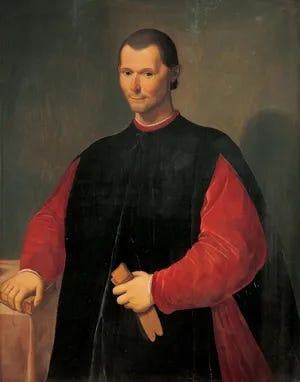
Niccolò Machiavelli wrote in his infamous booklet, the Prince that if one wants to be a great prince, one should study and imitate the past great princes. Perhaps surprisingly, this advice is relevant to modern liberal democracies too.
Great democratic leaders have certain qualities in common, and those who wish to follow in their footsteps would do well to learn what they are. Those who want to instruct students to understand and cherish their own democratic regimes should also teach those qualities. Doing that will lead students to understand the pitfalls and promise of democratic governance, and help them become better citizens and, perhaps, inspire some toward greatness.
In the United States, the person who defines the future course of the nation must always be the President. He must first win an election, having provided a clear approach to dealing with the pressing problem that divides and animates the country. That person must also establish a core principle that lives on beyond his initial election, one which addresses the crisis at hand but also applies to the lesser problems of human affairs that will inevitably follow.
Great American democratic leaders, then, create an ongoing durable coalition that rules or sets the terms of political debate for decades after they leave the political scene, thereby changing the entire character of the American regime. That is why they are great statesmen.
America has had four great leaders who can be emulated today: Thomas Jefferson, Abraham Lincoln, Franklin Roosevelt, and Ronald Reagan.
These four great leaders solved immediate crises that threatened the nature or survival of the country itself, and also created a new dominant political coalition from elements that had previously been in the minority.
Jefferson’s great challenge was whether the nascent American regime would be an aristocratic or a democratic republic. He said it should be a democratic one where the consent of the people would be required, and public figures could be freely criticized. Jefferson’s Republican Party (ancestor of today’s Democrats) won the election of 1800 narrowly but was so successful that the opposition Federalist Party disappeared by 1820 and Andrew Jackson extended Jefferson’s core principle to entrench his Democrats as the majority party into the 1850s.
Lincoln's challenge was just as daunting. He had to fight against the spread of slavery and establish human dignity and equality as America’s core principles, while creating an entirely new political party to replace the Whig Party that had collapsed by 1854. There was a competitor party, the Know Nothing party that was trying to make immigration, not slavery, the main question of the American regime. Anti-slavery Democrats were not eager to join their former Whig foes, and extreme anti-slavery abolitionists had to be brought into the fold without dominating. Lincoln’s party won and ended slavery. It then dominated national politics until the Great Depression, by applying Lincoln’s core principles of human dignity and equality to the problems of industrialization, creating a prosperous national economy while also regulating its excesses.
Franklin Roosevelt met the challenge of the Great Depression so thoroughly that he reinvented what it means to be an American. It's difficult to recapture what life was like prior to his 1932 victory . Today when we lose a job, we get unemployment insurance, which did not exist until after FDR’s victory. Extensive government regulation of the economy; Social Security; government support of the housing market: all these normal features of American life today started because FDR changed America’s understanding of itself.
FDR changed America by adding a new idea to those which Jefferson and Lincoln had established: security. He argued that liberty and equality required economic security, which could only be provided by the national government in the modern age. This principle has proved so enduring that LBJ and other Democrats created massive national programs – Medicare, Medicaid, food stamps, and so on – by hearkening back to FDR’s new principle.
FDRs influence was great. Reagan demonstrated the greatness of his influence by re-planting the trees of liberty and self-government into Roosevelt’s Garden. Reagan’s ability to define the challenges of the late 1970s – economic malaise, the rise of Soviet Communism, the decline of American patriotism – as stemming from the overreach of government and a misguided belief in the omnipotence of the state was so successful that now even Democrats must run as interpreters of his legacy.
It might appear that these men have nothing in common. They each had discrete challenges, discrete times, discrete personalities, and discrete modes of communication. But that’s not so.
Four things tie them together. The first is how they addressed public opinion.
Machiavelli recognized the importance of public opinion even for a tyrant. He advised the prince to create a climate of fear and respect so that people would fear for their lives or property if they crossed the prince, but without being so despotic that they would strive to overthrow him.
The democratic approach to public opinion is very different. Democratic political leadership requires persuasion. To persuade, the leader must accept and interpret where public opinion is, and move it in your direction without going too far.
Lincoln, for example, was attacked by, Stephen Douglas, his 1858 Senate campaign opponent for being a “black Republican,” or an abolitionist. Lincoln had to avoid that charge in a world where race prejudice was near universal. So, Lincoln argued for the equality of black people to earn their own living and keep what they earn while denying that he favored the social and political equality of the races. He understood how public opinion limited what he could say if he sought to build the coalition necessary to say that slavery is awful.
Second, Democratic leaders treat their adversaries differently than do tyrants. Machiavelli argued the prince should kill his adversaries, and tyrants like Vladimir Putin still follow that advice. Democratic leaders obviously do not kill opponents..
They do, however, rhetorically anathematize their adversaries. They create a binary moral choice that communicates that to solve this problem, there is my way, A, or their way, B. B is bad or evil or both. Jefferson said that John Adams and Alexander Hamilton were monarchists opposed to the very idea of the American republic. Lincoln’s “House Divided” speech argued that the Democrats were consciously trying to bring slavery to the North. Roosevelt called the Republicans Tories, Aristocratic British Conservatives, essentially arguing they were un-American.
The third characteristic of the great democratic leader is the leader’s relationship to the past. Machiavelli tells princes to present themselves as heirs to the city’s past. To establish new modes and orders, Machiavelli argued the prince must appear to perpetuate the existing regime even while effectively altering it.
Democratic leaders follow this advice. Jefferson interpreted the revolution in a way that claimed its mantle. Lincoln placed the Declaration of Independence at the center of the American regime, not the Constitution. He argued that the Republican view of the Declaration was the American view, while the Democratic view was contrary to its meaning. FDR consciously reinterpreted the American founding so that the expansion of the federal government was not seen as the antithesis of 1776, but its culmination.
Ronald Reagan is famous for his interpretation of the American idea. He argued the essence of America was self-government. Going back to the Mayflower Compact, he established that America was great because the people always ruled in a limited but effective fashion. By 1980, however, the bureaucracy and elites had taken over government and were no longer responding to the people.
Personal character is the final element common to great democratic leaders in America. Machiavelli argued that the prince must basically be Proteus. He must be a lion or a fox, switching between ferocity and cleverness depending on the need in his single-minded pursuit of power. The democratic prince must have prudence while also maintaining a clear, unaltering sense of the public good. Jefferson never contradicted his views regarding the rights of the people. Lincoln never denied the basic equality of the human being. FDR consistently said work and security rather than liberty were the essence of American individualism. Reagan was always consistent in his belief that democratic self-government, both here and abroad, were the central characteristics of a good regime.
Their prudence allowed them to change methods without changing ideals or goals. Reagan defined ideology as the idea that you would lop off the facts to meet your theory, and hence, itwas bad. Thus, Reagan could oppose tax increases and arms control, but sign many tax increases and negotiate an arms treaty with Mikhail Gorbachev when situations changed.
Roosevelt was a supporter of internationalism but rejected membership in the League of Nations to become the Democratic nominee. Lincoln would write privately of his hatred for the Know-Nothings, but couldn't oppose them publicly because he needed their support to defeat slavery. Prudence mixed with consistency is the character of a democratic statesman.
Teachers who use this approach can help save our country because they can teach the few who are ambitious how to act. They say that every senator sees a president in the morning when they look in the mirror. Trust me, at least a couple of your students, if you've been teaching long enough, see a president in the mirror at the age of 13 or 14; ambition starts that young.
Educators must inculcate a love of democracy early because the greatest souls, as Lincoln said in his “Lyceum Address,” won’t be satisfied with a seat in Congress or maybe even the presidency. They belong to the tribe of the lion or of the eagle, who see themselves and want to be seen as one of the great people of history. If they cannot see how to gratify their ambitions within a democratic framework, they will seek to undermine it.
This approach to teaching leadership will show students that great souls have often existed in the United States and have achieved undying fame by saving, not destroying, the American regime. Machiavelli wanted to be the advisor to real princes. He was unsuccessful in his own life, but he has been the posthumous teacher of tyrannical princes for centuries. The good educator can counteract his influence by becoming the teacher of democratic princes who can help save and continue the great experiment of the United States of America.