



About a decade ago, we held a long series of focus groups at Great Hearts to get a better sense of how prospective parents understood the terms we used to describe our educational model. I’ll never forget sitting in that dark room behind the one-way mirror, listening to the responses. Two, in particular, hit hard.
When asked how they understood the term “liberal arts,” many participants described it as “left-of-center music, art, drama instruction.” A few others described it as that general study program you take at a small college. And when asked how they understood the meaning of “the western tradition,” many agreed it had something to do with…cowboys. I’ll admit, I was astonished.
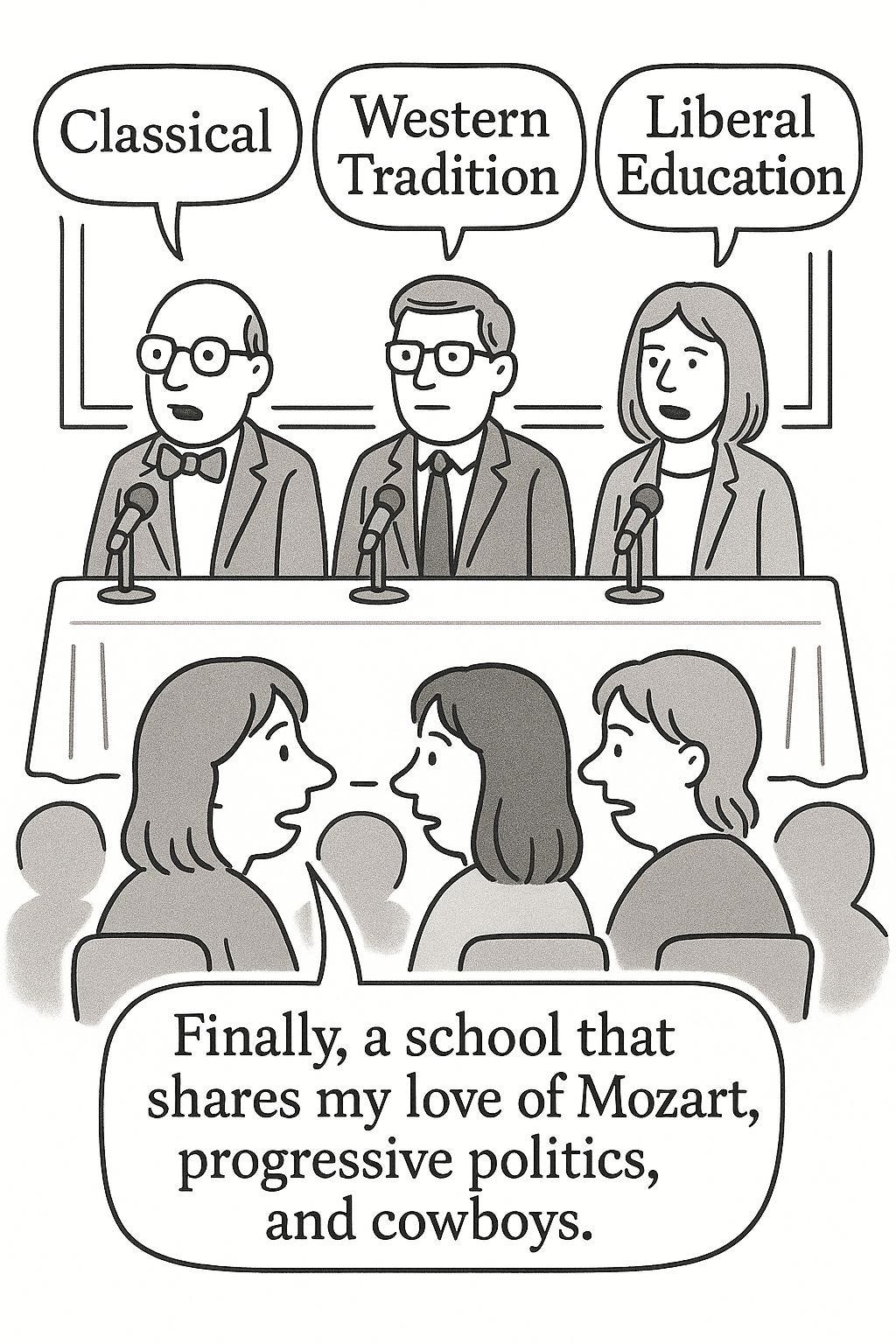
For those of us in classical education, these terms feel so basic, so self-explanatory, that we forget they aren’t part of most parents’ daily vocabulary. We imagine they convey depth and tradition. We imagine they inspire. Many times, they do. But too often they confuse, misdirect, or even foster suspicion among the very parents we strive to persuade. This isn’t a small problem, especially if we desire to see classical education serve more than the measly 1% of the K-12 population it currently claims.
What can be done about this? Do we jettison the terms and aphorisms we hold dear? Of course not. But can we retain them while also presenting the meat of the tradition to those only accustomed to milk?
Truth be told, it’s not that difficult. If you love something, you find you can speak about it in any manner of ways. The fact that some fellow travelers find it difficult to translate the richest expressions of what they love to “the masses” is more due to prior commitments that prevent the exercise than it is to any inherent inscrutability.
High Tongue
Let’s call the first commitment High Tongue. A few of my friends are high tongue. They worry that if we simplify the language of classical education, we risk betraying it. They argue that classical education is, by its nature, elevated. To speak of it in ordinary or colloquial terms, they suggest, is to do violence to the very thing we claim to honor. I understand the impulse. The classical tradition does indeed form our taste for what is fine, noble, and true. But is it not the case that this impulse becomes distorted when it confuses the dignity of an idea with the dignity of the person before us? Is the proper starting place the idea or the person? If our love for classical education exceeds our love for our neighbor, have we not lost the order of charity itself, and betrayed the tradition?
When Christ taught, He spoke in parables—simple images drawn from vineyards and coin purses and the seed that falls on rocky ground. He could have discoursed on the metaphysics of creation, but He chose the language of the field and the hearth because He loved those who listened more than He loved the perfection of His rhetoric. We might do well to follow His example. The question is not whether classical education deserves lofty speech; it certainly does. The question is whether the mother standing in a crowded gymnasium on a school-choice night, clutching a brochure and worried about her son’s future, can hear in our words that we love and care about the education of her child more than our own eloquence.
Evangelism—whether of faith or of philosophy—is a humbling art. It requires us to meet others eye-to-eye. This is not dishonesty; it is incarnation. To speak plainly is not to “dumb down” truth but to dress it in the garments that love requires. If our vocabulary serves as an ornate wall rather than an open door, we have turned language meant for communion into a form of self-admiration, even vanity. Classical education is not our beloved; the person before us is. And the mark of true love is that it wills the good of the other. It is always first patient and kind. When we talk to parents, our first goal should not be to stand on the high ground of our elevated ideas and principles but to love well by helping parents take the first, small steps on the path to understanding.
High Gate
The second commitment we’ll call High Gate. The High Gate are those who, more cynically, defend the inaccessibility of our language as a kind of gatekeeping. For them, the obscurity of our classical education terminology functions as a filter—ensuring that only the already-enlightened find their way in. They speak of “fit” and “alignment,” and behind these words sometimes lurks the quiet belief that classical schools thrive only when they remain small, pure, and untainted by the ordinary concerns of ordinary people.
This posture, while cloaked in prudence, is in truth an act of fear. It betrays a lack of faith in both the strength of classical education and the capacity of the human soul to be drawn upward. To restrict the gift of truth because some might mishandle it is to forget that grace, too, is offered to the undeserving. Sure, we need not cast our pearls before swine, but it is a grave mistake to assume that the uninitiated parents, lacking sophistication and maybe even a certain decorum, are swine. They are image-bearers longing for something truer and more beautiful for their children. Yes, they can’t articulate that very well. Yes, their horizons may be narrow and close. And, yes, they and their child might prove to be hard cases. Still, they deserve the gift of our hope and our effort, nonetheless.
As my friend and former boss Jay Heiler has often remarked, the future of classical education cannot be secured by a huddling remnant. If our schools become monasteries for the already converted, we will have betrayed the missionary heart of the movement. The measure of a classical school is not the polish of the families whose students matriculate, but the virtue of the students who graduate. We should not fear the “riff-raff”; we should fear becoming the Pharisees who thanked God that they were not like other men.
A Way Forward
We would do well to reclaim a charitable esteem for those still ascending the path. And we must repent of the quiet contempt we harbor. Too often we treat the unversed as unworthy, as though ignorance were a moral failing rather than the very condition education exists to heal. Classical education is, after all, not a reward for the already enlightened, but an act of love toward the still-forming soul. Only when we remember the dignity and promise of those outside our circles will we be ready to fulfill our vocation as educators.
If the “high tongue” and “high gate” impulses have hindered us, a part of the path forward must begin with listening. The classical movement will only grow if it learns to hear not just its own voice, but the voices of the parents standing outside the gate. Their questions—about readiness, safety, success, belonging—may sound utilitarian to our ears, but beneath them lie the deep, human anxieties of parental love and responsibility. Rather than dismiss these concerns as low or worldly, we should meet them as evidence of care rightly ordered, if imperfectly expressed. The task before us is not to scold parents for asking the wrong questions, but to show them that classical education answers their truest ones. To do this, we will need both the humility to listen and the willingness to translate—to reveal how the goods we hold most dear are not foreign to their hopes, but their fulfillment.
When parents ask about college readiness, they are really asking whether their child will have options. When they ask about test scores, they are asking whether the school is competent. When they ask about discipline, they are asking whether the community will provide order and safety. Too often, we respond in ways that make us sound indifferent to them. We tell them what Plato said about human flourishing when they need reassurance about college readiness; we dismantle utilitarian visions of education when they simply want proof that the school teaches effectively; we wax poetic on virtue when they are anxious about the basics of school safety.
The good news is that classical education easily clears all the low bars. Its graduates write clearly, think logically, and speak with confidence. They know things. Lots of things. They do well on tests. Our graduates excel in college and in life. Consistently, our schools are places of genuine warmth and joy, where real and lasting friendships are made, where cliques struggle to form. Of course, these are not the limits of our promise—they are merely the first proofs of its truth. We know classical education does not stop at forming competent workers; it aims to form wise and happy souls, so that the worker is a free man. Our challenge is to help parents see that the very things they most desire for their children—success, safety, confidence, knowledge, joy—are best secured by the slower, deeper, more rigorous path we offer.
This means finding new, winsome ways to tell that story. Most of us have experienced how a video showing a second-grader reciting poetry with delight communicates more than a brochure extolling the trivium. I’ve seen a billboard reading “Because your child deserves more than screen time” break through the divide more than a paragraph on Socratic pedagogy. The movement’s future depends on our ability to translate grandeur into warmth, philosophy into invitation, and truth into the common tongue.
Humility
If classical education is, at its heart, a recovery of love—love of truth, love of beauty, love of neighbor—then our rhetoric must sound like love. A movement of love does not obscure; it beckons. It does not flatter itself with its own refinement; it stoops to lift others up. The words we choose, the tone we adopt, the images we invoke—these either invite or repel. The rhetoric of a movement of love must therefore be marked by humility.
Humility means remembering that we were not born with classical minds. Most of us once stumbled through the fog of ignorance, malformed by modern schooling and consumer culture. If we were rescued by mentors, books, or divine providence, then we should speak as those who have been rescued, not as those who have always been safe on the shore. Our rhetoric should carry the tone of gratitude, not superiority. It should also be able to hit a common note. We don’t often do this very well.
For example, when describing our educational philosophy, we might say: “We pursue a form of education that rests upon a realist metaphysic: the conviction that truth, goodness, and beauty are not constructs but realities to be discovered and delighted in. The classical model—shaped by the trivium and quadrivium—invites students into the great conversation that has formed the mind of the West. It honors what Chesterton called, ‘The democracy of the dead.’ It is not innovation we seek, but participation in an inheritance that stretches from Athens to Jerusalem, Rome to Philadelphia, forming the intellect to mirror the order of creation itself.”
Contrast that with: “Here’s how we see it: kids come into the world curious, full of questions and wonder. Our job is to keep that spark alive and help it grow. We give them great stories to feed their imagination, teach them how to reason things out when the world gets confusing, and help them learn to speak and write with clarity and warranted confidence. By the time they graduate, they’ve spent years reading incredible books, discussing big ideas, doing hard and meaningful work, and learning to see the beauty that’s all around them—and, importantly, how to live like these things matter. It’s an old way of teaching that ends up being the best way to grow wise, competent, joyful young adults.” Both are true. One is full of dog whistles. One is a catchy tune.
Perhaps a movement of love should study the rhetoric of the saints together with the rhetoric of philosophers. St. Francis preached to peasants in their dialect; St. Paul spoke to Athenians in their idiom. When the early Church spread, it did not insist on Greek—it translated the gospel into Syriac, Coptic, and Latin. The truth did not weaken in translation; it multiplied. Likewise, classical education will only flourish when it learns to speak many tongues: the academic, the poetic, the pastoral, the parental. We need headmasters who can explain Aristotle to a donor at lunch, but also to a grandmother on a campus tour. We need teachers who can speak to their students about truth in one sentence and to their parents about college prep in the next—and mean both sincerely. We need lovers of our tradition who can describe it without once using the word “paideia.” We need them to be able to say, “We help children become the kind of adults you most admire,” without feeling they have demeaned themselves or the tradition.
In short, the rhetoric of a movement of love will not dilute the truth, it will amplify it through tenderness. It will remember that the point of the trivium and quadrivium, of Latin and logic and literature, is not to show the world how smart we are, but to help the world recover its soul. This is the movement of love. It speaks clearly, joyfully, and without pretense. It’s starting place is the other, not the self. It never talks down. It reaches down and lifts up. A movement of love endures. A movement of love is worth giving one’s life to. Let us be a movement of love.
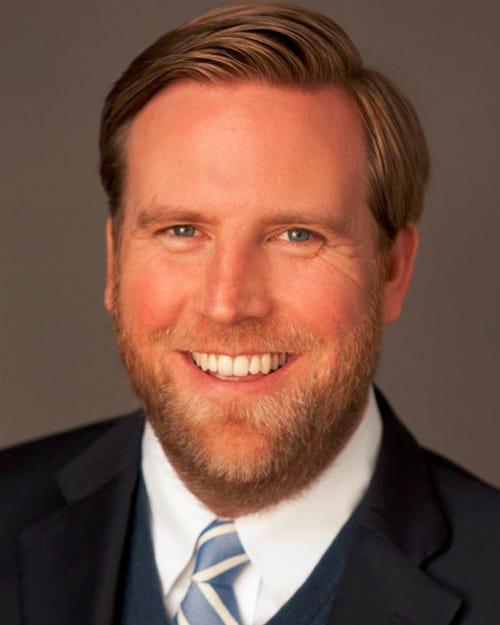
Erik Twist is the Principal Partner and President of Arcadia Education. From 2008 to 2022, Erik helped build Great Hearts Academies into the largest network of classical schools in the country. He served as president of Great Hearts Arizona from 2017 to 2022. Erik was a member of the Arizona State Board for Charter Schools from 2016 to 2021, as well as a member of the Arizona Charter Schools Association. Erik holds degrees from Trinity University, where he studied political science, and Oxford University, where he studied theology and philosophy. Erik has been married for 20 years to Allison and they have six children.
 |
|