


Sometime in 1776, an anonymous wit, wrestling over the question of which side to take in the War of Independence, published a poem called “The Pausing American Loyalist.” It imagines a man of property confronting the most consequential dilemma of the age: whether or not to join the Association pledging allegiance to the Patriot cause. He reached, without apparent deliberation, for Hamlet. “To sign, or not to sign? That is the question.” The joke depends on a recognition so instantaneous that it needed no setup; the original has been so thoroughly absorbed in early American culture that its parody was intelligible without it. Shakespeare had become, for the colonial mind, something close to a common language — and this in a culture that was in the very act of breaking from the nation that had formed him.
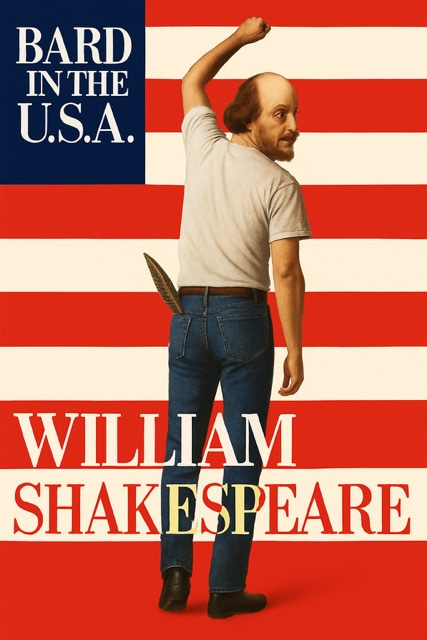
The revolution declared independence from British political authority. It did not declare independence from British literature, and the gap between those two positions tells us much about the distinctive nature of Shakespeare’s American life. What the soliloquy form offered — that peculiarly Shakespearean technology for staging a conscience under pressure, thinking aloud through irreconcilable alternatives — answered something deep in the political temper of the age. The revolutionary generation found in the plays a vocabulary for testing moral and political choices, for articulating the collision between private honour and public duty, for the peculiar vertigo of living through history. It was not yet the devotion — the bardolatry — that would develop in the following century, which came to America, like so much else in the cultural life of the 1800s, through British and German Romanticism: through Schlegel and Goethe, Coleridge and Carlyle, refracted across the Atlantic in the capacious intelligence of Ralph Waldo Emerson.
Emerson’s 1850 essay “Shakespeare; or the Poet” in his Representative Men is one of the great acts of critical ventriloquism. He appears to be offering a portrait of the playwright; he is in practice writing a manifesto for a certain conception of American selfhood. The Shakespeare he constructs is a universal intelligence, a brain “exhaling thoughts and images” so inexhaustible that the specific forms containing them barely matter. “He drew the man of England and Europe,” Emerson writes; “the father of the man in America.” That final phrase repays slow reading. Not the man in America — his social type, his manners, his institutions — but the father of the man: the interior, the self, the deep structure of consciousness that the new world was engaged in fashioning. It is a remarkable claim, advanced with the serenity of one who considers it self-evident.
As Emerson was writing, Ira Aldridge, the first great Black Shakespearean actor, was doing something that the New York culture into which he was born insisted was impossible: embodying Othello with consummate theatrical intelligence while actually bearing the colour of his skin, as no prominent actor before him had done. Aldridge achieved his success on the stages of Britain and Europe. William Wells Brown, who saw him perform in 1862, watched his Othello with wonder, then returned to the theatre the following night and “was surprised to find him as perfect in that as he had been in Othello; for I had been led to believe that the latter was his greatest character. The whole court of Denmark was before us; but till the words, ‘’Tis not alone my inky cloak, good mother,’ fell from the lips of Mr. Aldridge, was the general ear charmed, or the general tongue arrested. The voice was so low, and sad, and sweet, the modulation so tender, the dignity so natural, the grace so consummate, that all yielded themselves silently to the delicious enchantment.” Every fiber of the antebellum racial imagination insisted that the inner life of Hamlet — that supreme symbol of introspective, melancholic, northern European sensibility — was by definition inaccessible to a Black man. Aldridge’s performance did not simply challenge that prejudice; it made it look not merely wrong but unintelligible. But America was not ready for him.
Abraham Lincoln came to the plays not through formal education, of which he had little, but as an auto-didact, an inveterate reader. Writing in 1863 to the actor James Hackett, he achieves a tone of unpretentious candor: “I think nothing equals Macbeth. It is wonderful.” He also ventures, with characteristic self-deprecation, a preference for King Claudius’s guilty soliloquy in Hamlet (“O, my offence is rank”) over the more celebrated “To be, or not to be.” Lincoln, living inside the largest moral catastrophe his country had ever faced, knew from experience what it was to be responsible for lives and deaths, and to want absolution. Shakespeare had written for that condition too.
What Lincoln could not have known, as he wrote that letter in August 1863, was that his own assassination would be at the hands of a Shakespearean actor. John Wilkes Booth, who shot him in a theatre in April 1865, had performed in Julius Caesar less than a year before (he played Antony alongside his brothers Edwin and Junius Brutus as Brutus and Cassius). Booth deeply admired Brutus, the assassin of Caesar, and saw him as a heroic figure who killed a tyrant to save the Roman Republic. It is a grotesque piece of literary self-fashioning, and it illuminates the double edge of Shakespeare’s American inheritance. The same plays that gave Lincoln the great man a language for moral reckoning gave Booth the assassin a language for self-justification. The texts do not choose their readers.
Mark Twain, who had opinions about most things and was wrong about fewer of them than he pretended, was wrong about Shakespeare. His 1909 broadside on behalf of the Baconian heresy is a magnificent piece of comic demolition: the life assembled from deer-stealing, horse-holding outside the theatres, and a “second-best bed,” was so uneventful that it could hardly belong to a man of genius. Indeed, “How curious and interesting is the parallel—as far as poverty of biographical details is concerned—between Satan and Shakespeare.” But this is the wrongness of a very clever man seduced by a category error. Twain could not reconcile the glover’s son from Stratford with the author of the plays because he could not believe that provincial obscurity might coexist with universal genius. The assumption that greatness must leave a paper trail, that the self must be thoroughly documented in order to be real, is, in its way, a peculiarly American confusion. The authorship controversy has always found its most passionate adherents in America, and the reason is not difficult to see. A culture built on self-invention, on the founding proposition that origins need not determine destiny, is simultaneously drawn to conspiracy and unsettled by the idea that the greatest writer in the language might have been, in worldly terms, no one in particular. Shakespeare the untraceable becomes, in such a culture, Shakespeare the threatening.
Whereas Twain exemplified the demythologizing impulse in America’s relationship with Shakespeare, Henry Clay Folger represented its precise opposite. The Standard Oil millionaire spent forty years accumulating First Folios and Shakespeareana with the focused intensity of a man who believed he was collecting relics and left behind in Washington DC the library that bears his name: the greatest Shakespeare collection in the world. When the Folger Shakespeare Library opened in 1932, its first director was Joseph Quincy Adams Jr, scion of a family that had produced two American Presidents. He had no difficulty articulating the purpose of the whole enterprise. Shakespeare, he argued, had served as cultural cement in a nation perpetually at risk of flying apart. As immigration transformed American cities and risked disintegrating the nation into a “babel of tongues and cultures”, Shakespeare “was made the corner-stone of cultural discipline. A study of his works was required in successive grades extending over a period of years. Elaborately annotated texts of his plays were devised, and sold in editions running into millions. Everywhere pupils were set to the task of memorizing his lines, of reciting on platforms his more eloquent passages, of composing innumerable essays on his art, his technique, his ideals of life, his conceptions of character, of presenting his plays in amateur theatricals.” The vision is at once noble and troubling. The Shakespeare who holds America together in Adams’s account is recognizably the Shakespeare of the English-speaking peoples, the cornerstone of a specifically Anglo-Protestant inheritance; and the question of whose children are doing the memorizing, and whose culture is being preserved, is one that Adams does not ask. Others would.
The 1930s gave Shakespeare’s American afterlife a new and urgent political charge. In 1937, Orson Welles — twenty-two years old and constitutionally incapable of thinking small — staged Julius Caesar for his Mercury Theatre with the conspirators in black fascist uniforms and Rome reimagined as a contemporary police state. The production has since become so canonical that it is easy to forget how radical it was: not an analogy between ancient Rome and modern authoritarianism, but an identification, an insistence that Shakespeare’s play had nothing to do with the past. The moment that lodged in memory was the death of Cinna the poet, the innocent man swallowed by a mob that does not stop to ask whether he is the right Cinna. In Welles’s staging — pools of light, encroaching darkness — the scene became an image of pure, arbitrary terror: the intellectual destroyed for what he is rather than what he has done. In the Europe of 1937, it was not a metaphor.
The previous year, Welles had done something equally audacious with Macbeth, relocating it to Haiti, recasting the witches as voodoo priests, filling the stage of the Lafayette Theatre in Harlem with an all-Black company. The “Voodoo Macbeth,” produced for the Federal Theatre Project under the New Deal, was both a provocation and a gift: it insisted, before the argument had been formally articulated, that Shakespeare belonged to everyone, that the Scottish play could breathe as freely in the Caribbean as in Stratford or on Broadway. It prepared the ground for what followed.
When Paul Robeson took the stage as Othello in 1943, the event carried a weight of significance that no single performance should have to bear, and bore it with extraordinary dignity. Samuel Sillen, writing in the left-wing journal The New Masses, grasped that Robeson’s achievement was not merely theatrical:
Paul Robeson’s Othello is indescribably magnificent … the authentic Moor of Shakespeare’s towering vision, a colossus among men … In his bearing, his tone, his look, Robeson invests the character with incomparable tragic dignity … He bursts through the petty dimensions of the contemporary stage … sending a profound shock of discovery … He reanimates a great tradition of significant and resonant speech… No artist in our lifetime has so triumphantly gripped us … It is more than a personal triumph, it is a historic triumph that we have been privileged to witness … For the first time on the professional stage in America we have seen a Negro Othello … The theater that … exiled Ira Aldridge has at last embraced Aldridge’s successor … October 19, 1943, is an emancipation date … Not only are we seeing our first Negro Othello, but perhaps our greatest Othello.
But what made the production scandalous to a portion of its audience was simpler and uglier than any question of acting technique. For some, though, the sight of a Black man, night after night, taking a white woman in his arms was abhorrent. The interracial casting drew protests and threats, confirming what did not need confirming: that Shakespeare in America was never simply about Shakespeare. The plays were a proxy for the argument America was conducting with itself.
James Baldwin understood this more deeply than anyone. His essay of 1964, “Why I Stopped Hating Shakespeare,” begins with an admission that for a long time he hated Shakespeare because he did not find his own people there. But eventually, he came to see that empathy matters more than identity: “The greatest poet in the English language found his poetry where poetry is found: in the lives of the people. He could have done this only through love—by knowing, which is not the same thing as understanding, that whatever was happening to anyone was happening to him.” The American writer who follows in Shakespeare’s footsteps has a responsibility, Baldwin argues, which is also a joy and a strength and a life, “to defeat all labels and complicate all battles by insisting on the human riddle, to bear witness, as long as breath is in him, to that mighty, unnameable, transfiguring force which lives in the soul of man, and to aspire to do his work so well that when the breath has left him, the people—all people!—who search in the rubble for a sign or a witness will be able to find him there.” To defeat all labels and complicate all battles: that is what Shakespeare did and that is why he is for every American.

Sir Jonathan Bate is Regents Professor of Literature and Foundation Professor of Environmental Humanities at Arizona State University and a Senior Research Fellow at Oxford University, where he was formerly Provost of Worcester College. He is the author of twenty books, including The Genius of Shakespeare; Soul of the Age: A Biography of the Mind of William Shakespeare; and, most recently, Mad about Shakespeare: Life Lessons from the Bard. He has been on the Board of the Royal Shakespeare Company and edited their edition of the Complete Works. Being Shakespeare, his one-man play for Simon Callow, premiered at the Edinburgh Festival toured the United Kingdom, had three runs in London’s West End, and played in New York, Chicago and Trieste.